The September 15, 2026 Tax Deadline: What's Actually Due
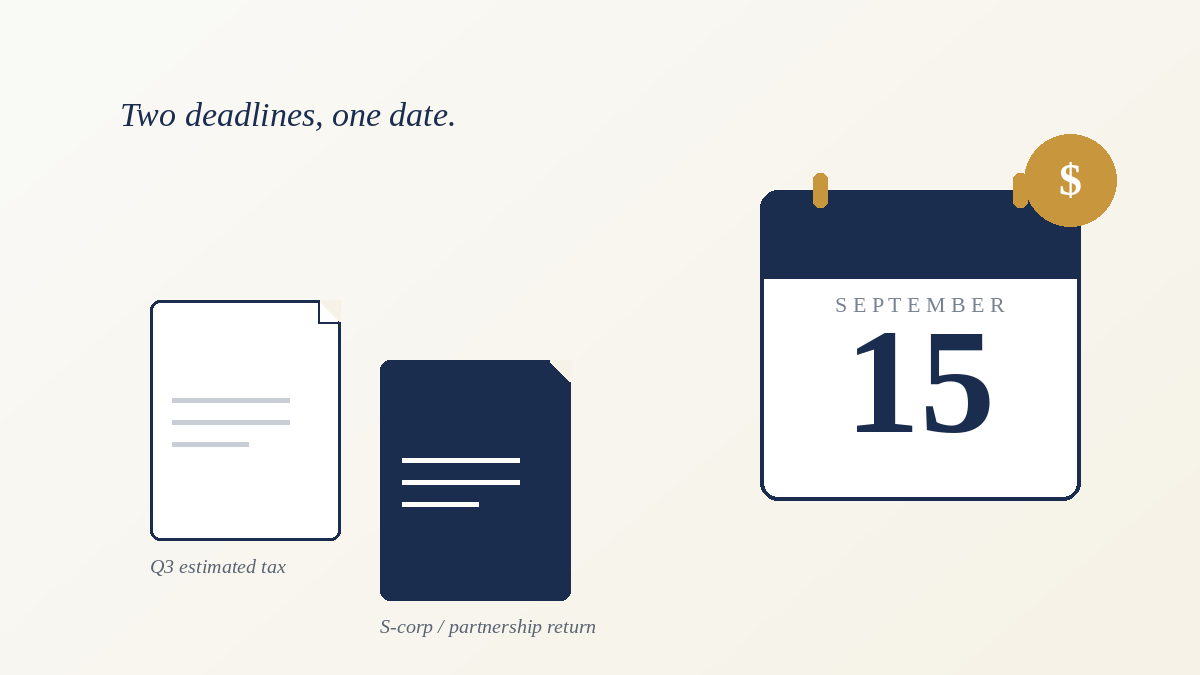
September 15, 2026 falls on a Tuesday, and if you pay quarterly estimated taxes or run a business that filed an extension back in March, it's a date worth circling now. The tricky part is that "the September 15 deadline" isn't one thing — it's two unrelated deadlines that happen to share a date, and mixing them up is an easy way to miss one.
What's actually due September 15
- Q3 2026 estimated tax payment. If you're self-employed, a freelancer, or otherwise pay quarterly estimated taxes because you don't have an employer withholding for you, your third-quarter payment for 2026 is due this date.
- Extended S-corp and partnership returns. Calendar-year S-corporations (Form 1120-S) and partnerships (Form 1065) that filed a six-month extension back in March are now at the end of that extension — the return itself is due September 15.
These two deadlines have nothing to do with each other, but they land on the same day. It's entirely possible to owe one, both, or neither — it depends on how you're structured and how you pay tax throughout the year.
Who this actually affects
- Content creators and 1099 contractors who make estimated payments instead of having tax withheld from a paycheck.
- Small business owners operating as an S-corp or partnership who extended their business return in March.
- Anyone with significant untaxed income this year — a large freelance project, rental income, or investment gains — who makes estimated payments to avoid a penalty at filing time.
If you're a W-2 employee with taxes withheld from every paycheck and no side income, this date generally doesn't apply to you.
What happens if you miss it
Missing the S-corp/partnership filing deadline triggers a late-filing penalty that accrues by the month, and it can add up fast on a return with several partners or shareholders, since the penalty is often calculated per person, per month late. Missing an estimated tax payment doesn't come with a flat fee — instead, the IRS charges an underpayment penalty based on how much was owed and how late it arrived, calculated like interest rather than a single charge. In both cases, filing or paying something late is better than not filing or paying at all — the penalties are built to scale with the delay, not to punish an honest attempt equally with silence.
How to stay ahead of it
- Confirm which of the two deadlines actually applies to you
- If you extended a business return, get documents to your preparer now, not on September 14
- If you owe estimated tax, pay what you can even if it's not the full amount
- Calendar the next estimated payment date (January 15) while you're at it
For the bigger picture on how tax prep pricing works and what drives your bill up or down, see How Much Does a Tax Accountant Cost?.
Common questions
I filed an extension in March — does September 15 apply to me?
Only if you extended an S-corporation (Form 1120-S) or partnership (Form 1065) return. Extended individual returns (Form 1040) have until October 15, not September 15 — it's an easy date to mix up, so double-check which form you extended.
Does the extension also extend when I have to pay?
No. An extension gives you more time to file the paperwork, not more time to pay what you owe. If your business owed tax for last year, that was due back in March regardless of the extension — September 15 is a filing deadline, not a fresh payment deadline for that return.
What if I can't pay my Q3 estimated tax in full?
Pay what you can by September 15 anyway. The underpayment penalty is calculated on whatever portion is late, so a partial payment on time still reduces what you'll owe compared to paying nothing until later.
What if September 15 falls on a weekend?
The deadline shifts to the next business day. In 2026, September 15 is a Tuesday, so no shift applies — the deadline is the date itself.
Not sure which deadline applies to you?
Tell me about your business and how you pay tax on a free discovery call, and you'll leave knowing exactly what's due, when, and what it takes to file it right.
Book a Free Discovery Call →Already know you're ready? Book your tax appointment directly →